For most of recent history, technology has demanded our attention, but that relationship may be starting to change.
Imagine technology that recognizes what is happening around you, processes information in the background, and responds. Your environment becomes part of the computing experience, with sensors, artificial intelligence, connected devices, and wearables working together without constantly demanding your attention.
Patrick Putman of Alabama says that this is the promise of ambient technology, and it could represent one of the biggest changes in computing since the arrival of the smartphone. Ambient technology aims to make the technology itself less noticeable – and this concept itself is not entirely new.
Computing Is Moving Beyond the Screen
The personal computer changed the way we live and work. The smartphone changed it again by putting what was once desktop technology at our fingertips. Ambient technology represents another major transition by making computing less dependent on a specific device at all.
In an ambient environment, computing is distributed across numerous objects and locations.
- A thermostat can monitor conditions inside a home.
- A wearable can track movement or activity.
- A vehicle can process information about its surroundings.
- A security system can recognize unusual activity.
- A smart speaker can respond to a request without requiring a screen.
These devices can increasingly work together and interpret information. The technology becomes more ambient when the computing infrastructure fades into the background and the user focuses on the task rather than the device.
Artificial Intelligence Makes Ambient Technology More Useful
The potential of ambient systems is to analyze information continuously and determine when an action is appropriate. Instead of asking a system to perform every individual step, users establish preferences or goals and allow software to handle routine decisions.
For example, an ambient home system could recognize that someone has arrived, determine the conditions inside the house, adjust lighting or temperature according to established preferences, and notify the homeowner if something appears unusual.
The same principle could apply in workplaces. Sensors monitor equipment, environmental conditions, occupancy, or production processes while AI systems identify patterns that deserve attention.
This does not mean machines will independently make every decision. In many situations, the more realistic near-term model is AI-assisted automation, where software handles routine observations and recommendations while people remain responsible for important decisions.
The Number of Connected Devices Is Creating the Foundation
Ambient computing also depends on a massive underlying expansion of connected devices. Ericsson estimates that there were approximately 22.3 billion Internet of Things connections globally at the end of 2025, including both cellular and short-range connections. Its forecast projects that total to reach about 47.1 billion by 2031.
A future environment might contain sensors that measure temperature, motion, location, equipment performance, air quality, energy consumption, and other variables. Individually, many of these devices may perform relatively simple tasks. Collectively, however, they can create a detailed digital representation of what is happening around them.
The result is a computing environment that is no longer concentrated inside a desktop, laptop, or smartphone.
Edge Computing Could Make Responses Faster
Another important piece of ambient technology is edge computing. Sending every piece of information to a distant cloud data center can introduce latency and create additional bandwidth and privacy considerations. Edge computing moves some processing closer to where data is generated.
That can be particularly valuable for systems that need to react quickly.
Consider an industrial machine equipped with sensors. If a system detects an abnormal vibration that could indicate mechanical failure, processing that information locally could allow the system to respond immediately rather than waiting for data to travel to a remote server and back. The same principle can apply to vehicles, security systems, medical technologies, robotics, and other applications where timing matters.
As connected devices become more capable, ambient computing can therefore become less dependent on a single centralized computer. Processing can be distributed across the environment itself.

Wearables Could Become a Major Interface
Smartphones are currently one of the primary ways people interact with digital services, but wearables could become increasingly important in an ambient computing environment.
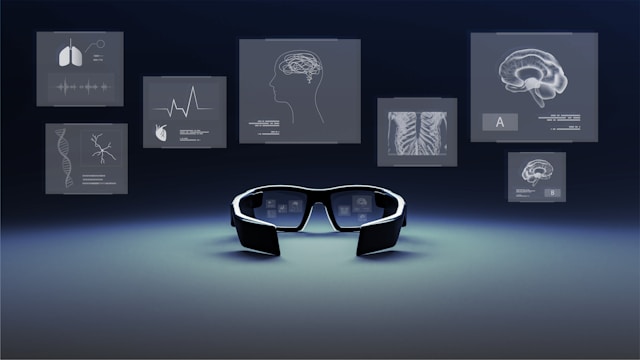
Smartwatches already provide notifications, health and activity information, navigation, communication, and other functions without requiring a person to pull out a phone. Smart glasses take this idea further by placing information and AI assistance within the user’s field of view. The market remains relatively early, but the hardware is expanding. In fact, global smartglasses shipments reached approximately 10 million units in 2025, with analysts expecting strong double-digit growth in the following years.
Audio-enabled glasses may be particularly important because they can provide computing assistance without requiring a conventional display. A person could potentially ask a question, receive directions, identify something in their surroundings, or communicate with another person while keeping their hands and attention focused on the physical world.
That represents a different philosophy from smartphone computing: technology becomes something a person interacts with while continuing to do something else.
Ambient Technology Could Change the Way Businesses Operate
The implications extend well beyond homes and personal devices.
Businesses already use connected sensors and automated systems to monitor inventory, equipment, energy use, building conditions, and production processes. Ambient computing could bring these capabilities together with AI systems that can recognize patterns and initiate appropriate actions. The broader objective is to reduce the amount of routine monitoring people have to perform manually.
Instead of employees constantly checking dashboards for problems, computing systems could watch the underlying environment and bring important information forward when it matters.
Privacy May Become the Biggest Challenge
The convenience of ambient technology comes with an obvious trade-off: these systems may need to observe more of the world around them.
A smartphone generally collects information when a person actively uses it. Ambient systems can be designed to continuously sense their surroundings. That raises significant questions about microphones, cameras, location information, biometric data, behavioral patterns, and other forms of personal information.
NIST warns that Internet of Things devices can create cybersecurity and privacy risks that differ from those associated with conventional information technology. It also emphasizes the importance of considering those risks throughout the lifecycle of connected devices.
For ambient technology to gain widespread acceptance, people will need understandable controls over what is collected, why it is collected, where it is processed, how long it is retained, and who can access it. Convenience alone will not be enough if users feel they have surrendered control over their personal environments.
Security Will Become More Complicated
Ambient computing could also expand the number of potential entry points for cyberattacks.
A traditional computing environment might involve computers, phones, servers, and networking equipment. An ambient environment could also contain hundreds or thousands of connected sensors and devices.
Manufacturers will need to build stronger security into devices, while organizations and consumers will need better ways to update, monitor, authenticate, and manage connected equipment.
The success of ambient computing may therefore depend as much on cybersecurity and privacy engineering as on advances in AI.
The Interface May Eventually Become Less Visible
The most significant change ambient technology could bring may not be a new gadget. It could be the gradual disappearance of the traditional computer interface.
People have spent decades learning how to interact with computers through keyboards, mice, touchscreens, menus, and applications. Ambient technology could reduce the importance of those interfaces by allowing people to communicate through voice, gestures, context, sensors, and increasingly natural interactions.
That does not mean screens will disappear. Laptops, phones, monitors, and tablets will remain useful for many tasks.
Instead, computing could become multimodal and distributed. A person might use a screen for detailed work, voice for a quick request, glasses for contextual information, and a wearable for authentication or notifications – all while an invisible network of sensors and software handles background tasks.
The computer would still be there. It simply would not always look like a computer. And as more of the computing process moves into the environment itself, interacting with technology could become less about operating a device and more about simply getting things done.